
AR-Enhanced Bus Stop
Experience
Improving Public Transport Waiting Through Augmented Reality
.png)
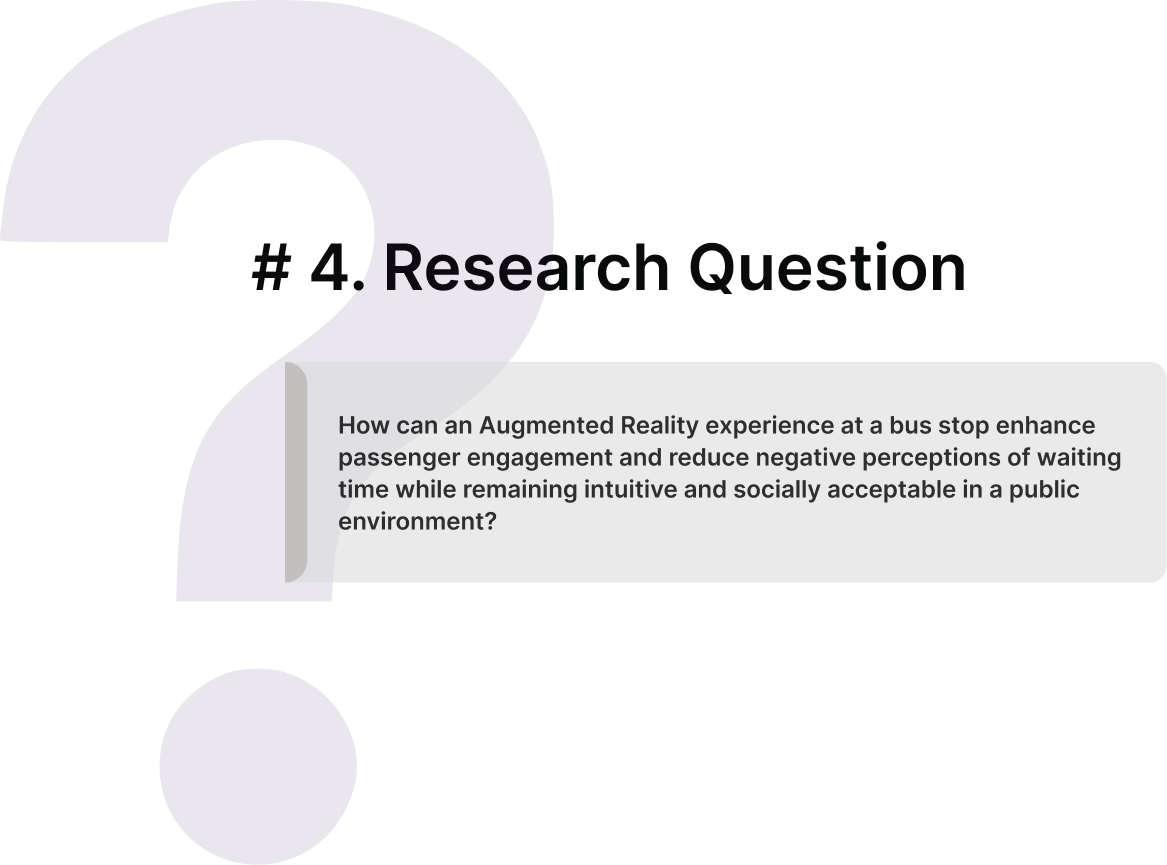
Waiting for public transport often creates moments of boredom, uncertainty, and frustration for passengers. This project explored how Augmented Reality (AR) could enhance the waiting experience by introducing lightweight digital interactions layered onto the physical bus stop environment.
The concept focused on an AR-enhanced bus stop display where passengers could briefly interact with playful elements while also accessing real-time bus arrival information.
Rather than introducing technology purely for entertainment, the project investigated how context-aware interactions could improve the emotional experience of waiting without distracting users from their primary goal—catching the bus.
# 1. Context & Core Problem
Problem:
Passengers waiting for public transport often experience boredom, uncertainty about arrival times, and limited engagement in the waiting environment.
Goal:
Explore how Augmented Reality could improve the waiting experience by providing lightweight interactive moments while still supporting access to real-time bus information.
Outcome:
A prototype AR bus stop interaction demonstrating how mixed reality could:
- Reduce perceived waiting time
- Increase engagement during waiting
- Provide useful transport information in an intuitive way
# 2. My Contribution
In this project I was responsible for:
# 3. Problem
Public transport waiting environments often produce negative user experiences.
Initial contextual observations revealed several
common issues:
These insights suggested an opportunity to design a system that enhances
the
waiting experience while
maintaining awareness
of transport information.
.png)
# 5. Research Approach
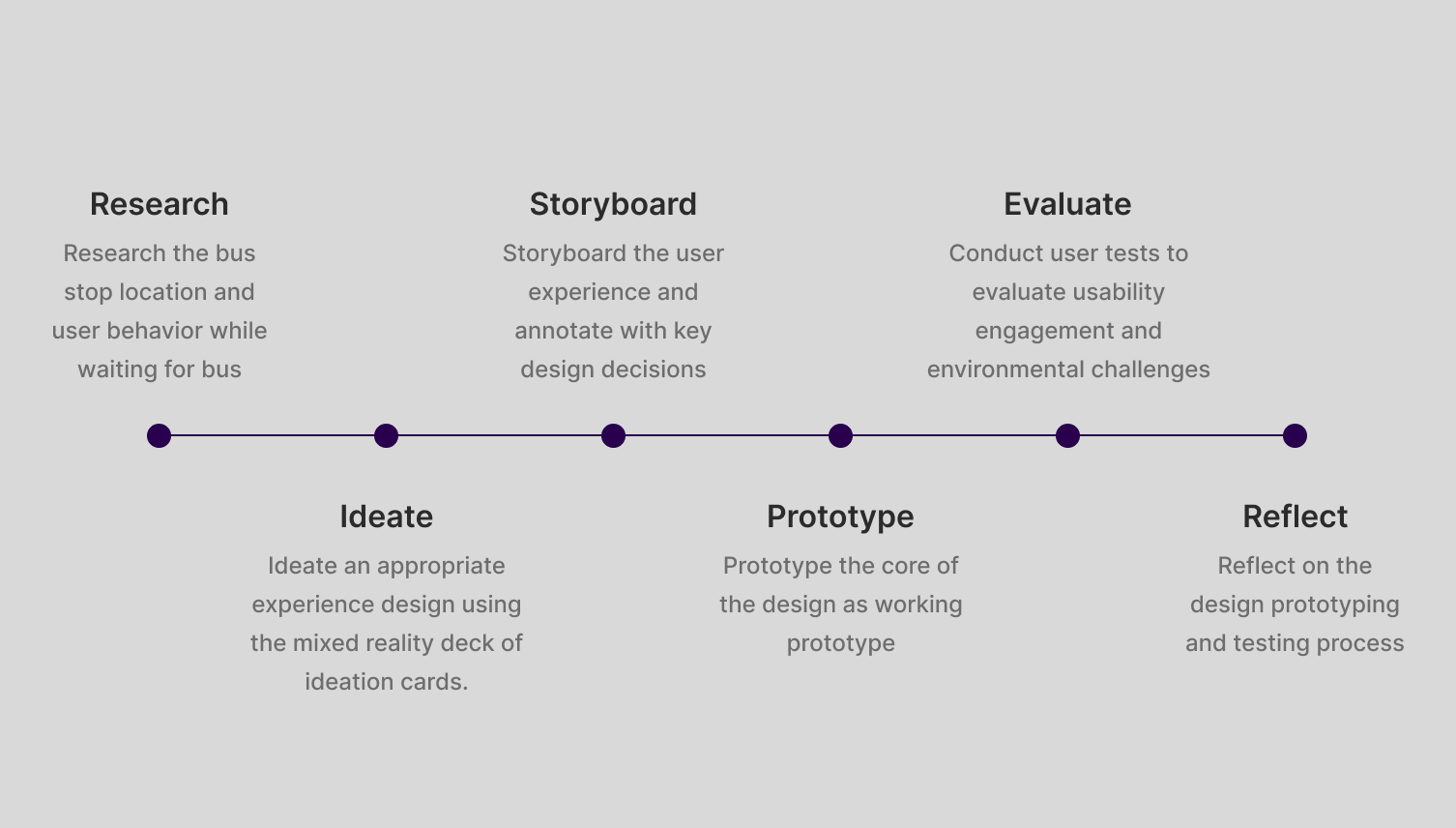
A research-through-design methodology was used to explore the problem. The project combined contextual investigation, iterative design, and prototype evaluation.
The evaluation focused on:
- Learnability
- Engagement
- Perceived usefulness
- Comfort interacting in public spaces
# 6. User Journey Analysis
To understand where AR could improve the experience, the passenger journey at the bus stop was mapped.
# 7. Design Concept
The AR experience was structured around short interaction stages that reflect real-world passenger behavior.
Instead of continuous engagement, the system supports brief, interruptible interactions, allowing passengers to remain aware of their surroundings and bus arrival updates.
Interaction Stage 1: Discovery & Onboarding
Passengers discover the experience through a visual marker placed inside the bus shelter.
Design goals:
- Walk-up-and-use interaction
- No app download required
- Immediate engagement
.png)
.png)
Interaction Stage 2: Lightweight AR Engagement
The first interaction introduces a simple balloon-popping AR game designed for quick interaction.
The activity was intentionally designed to be:
- Easy to understand
- Gesture-based
- Short and optional
Passengers can interact briefly while waiting without losing awareness of their surroundings.
Interaction Stage 3: Emotional Engagement
A playful AR character interaction was introduced to improve the emotional quality of waiting.
This stage focuses on:
- Mood improvement
- Delight and novelty
- Short optional engagement
The goal is to make the waiting experience feel shorter and more enjoyable.
.png)
.png)
Interaction Stage 4: Real-Time Transport Information
The AR interface integrates real-time bus arrival updates to support the user's primary goal.
Benefits include:
- Reducing uncertainty about bus arrival times
- Providing glanceable transport information
- Maintaining awareness while interacting
Interaction Stage 5: Exit & Task Resumption
When the bus arrives, the system provides a clear visual exit signal.
This ensures the interaction:
- Does not distract passengers
- Allows a smooth transition back to real-world tasks
.png)
# 8. Key UX Insights
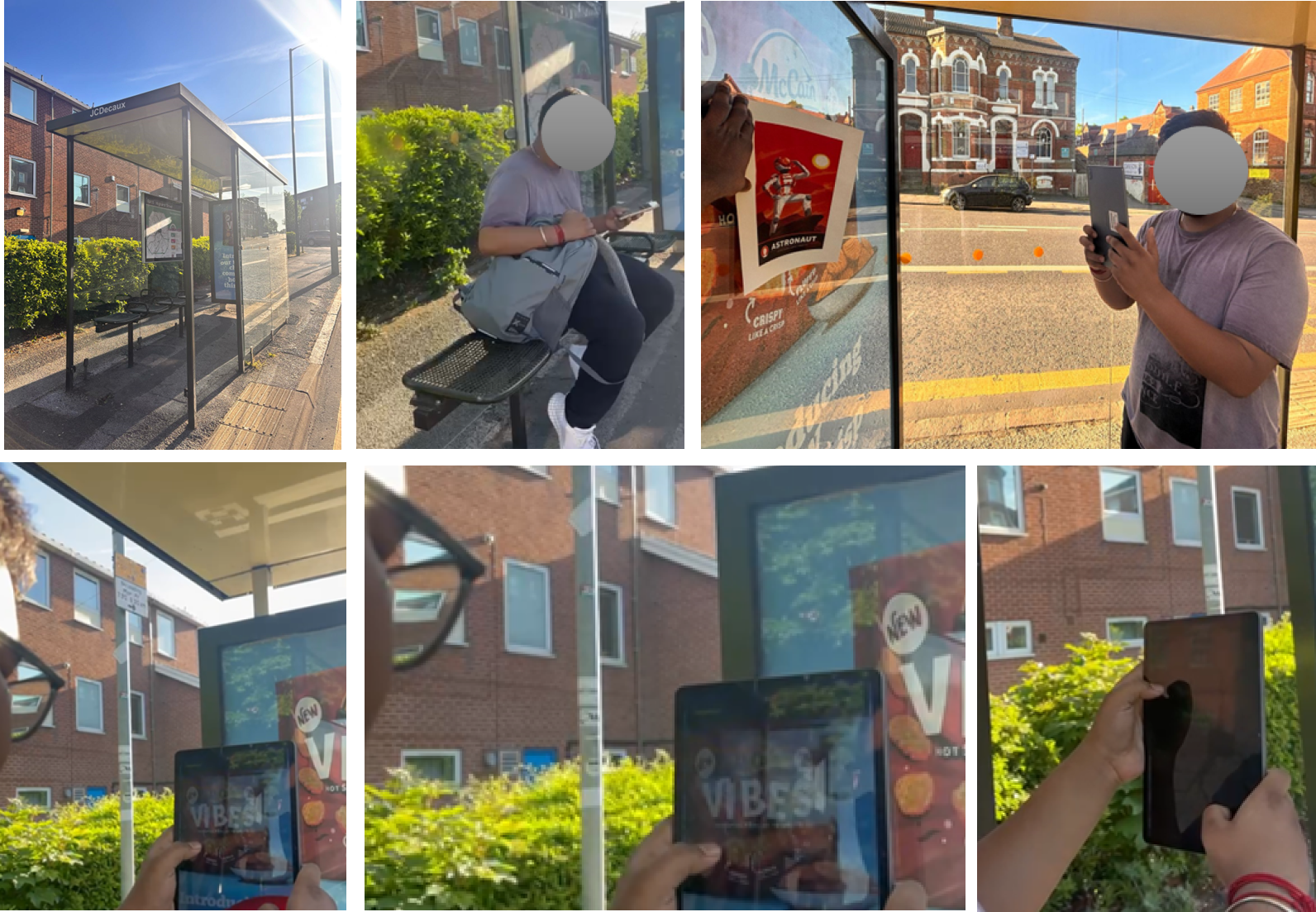
User testing revealed several important insights.
Interactive Engagement Reduces Perceived Waiting Time
Participants reported that waiting felt shorter and more enjoyable when interacting with the AR experience.
“When you're just standing here waiting, it feels like the bus takes forever.”
Social Comfort Influences Engagement
People initially hesitate to interact in public, but quick and rewarding interactions reduce hesitation.
Simplicity is Essential in Public Interaction
Users must understand how to interact within seconds, as attention is divided in public environments.
Environmental Factors Matter
Outdoor conditions such as lighting and noise influence interaction visibility and feedback clarity.
# 9. UX Design Principles
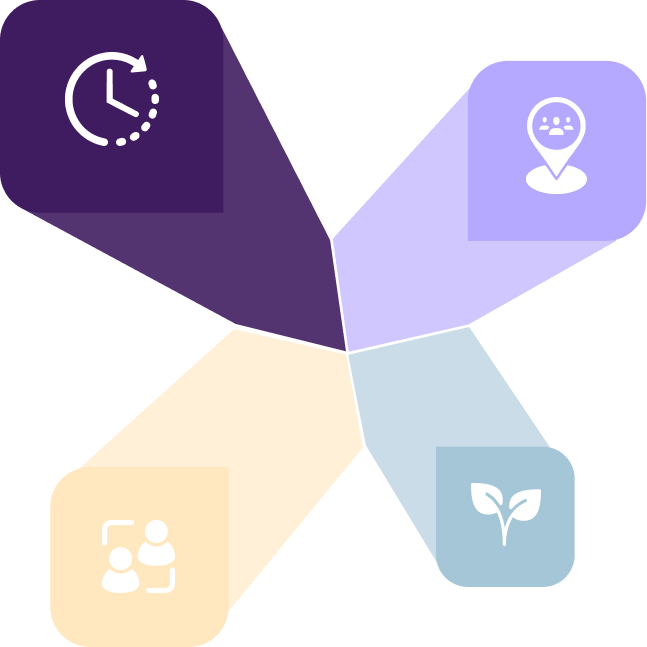
From the research findings, five design principles were derived for public mixed-reality experiences.
# 10. Final Concept
The final concept demonstrates how Mixed Reality can enhance public transport environments by combining interactive moments with real-time information.
The system improves waiting experiences by:
- Increasing engagement
- Reducing boredom
- Improving perceived waiting time
- Supporting passenger awareness
# 11. Reflection
This project highlighted the importance of designing Mixed Reality experiences that respect real-world contexts.
In public environments, successful interaction design must prioritise:
- Simplicity
- Social acceptability
- Environmental awareness
- Task prioritisation
Future work could explore long-term deployment of AR-enabled transport environments, integrating live transport APIs and supporting multi-user interaction.